
 HI
HI  EN
EN  DE
DE  IT
IT  FR
FR  RU
RU  ES
ES  JA
JA  PT
PT  KO
KO  TR
TR  DA
DA  TH
TH  MN
MN  VI
VI  AR
AR How B2B Buyers Should Compare Resin and Acetate Watch Materials
For B2B watch buyers, choosing between resin and acetate watch materials should never be based on price and appearance alone.
A watch is a product that may remain in direct contact with the skin for many hours every day. This means material composition, chemical control, supplier transparency, comfort, and long-term skin-contact suitability should all be considered during sourcing.
Synthetic resin watches can be inexpensive and easy to manufacture. However, “resin” is a very broad material category. Different suppliers may use different polymers, plasticizers, pigments, fillers, recycled feedstocks, stabilizers, and processing additives.
If these formulations are poorly controlled or insufficiently tested, B2B buyers may face unnecessary chemical-compliance and skin-contact risks.
High-quality cellulose acetate, especially acetate used in premium eyewear, offers a different sourcing proposition. It has an established history in products that remain close to or directly against the skin, while also providing rich colors, smooth polishing, lightweight comfort, and premium fashion appeal.
For fashion brands, wholesalers, distributors, retailers, and private label buyers, understanding these differences can help create safer, more reliable, and more valuable watch collections.
Resin and Acetate Are Not the Same Material
Although resin and acetate watches may sometimes look similar in product photos, the materials should not be treated as interchangeable.
What Is Synthetic Resin?
“Resin” is a general term that may refer to many different synthetic polymer systems.
Depending on the manufacturer, a resin watch may contain:
- Synthetic polymers
- Plasticizers
- Pigments and colorants
- Stabilizers
- Fillers
- Processing aids
- Recycled plastic content
- Surface coatings
Two products both described as “resin watches” may therefore use completely different formulations.
For B2B buyers, this is important.
A specification sheet that simply says “resin” does not automatically tell you:
- What polymer is used
- What additives are present
- Whether recycled materials are included
- Whether restricted substances have been tested
- Whether the finished component is appropriate for repeated skin contact
That information should be verified with the supplier.
What Is Cellulose Acetate?
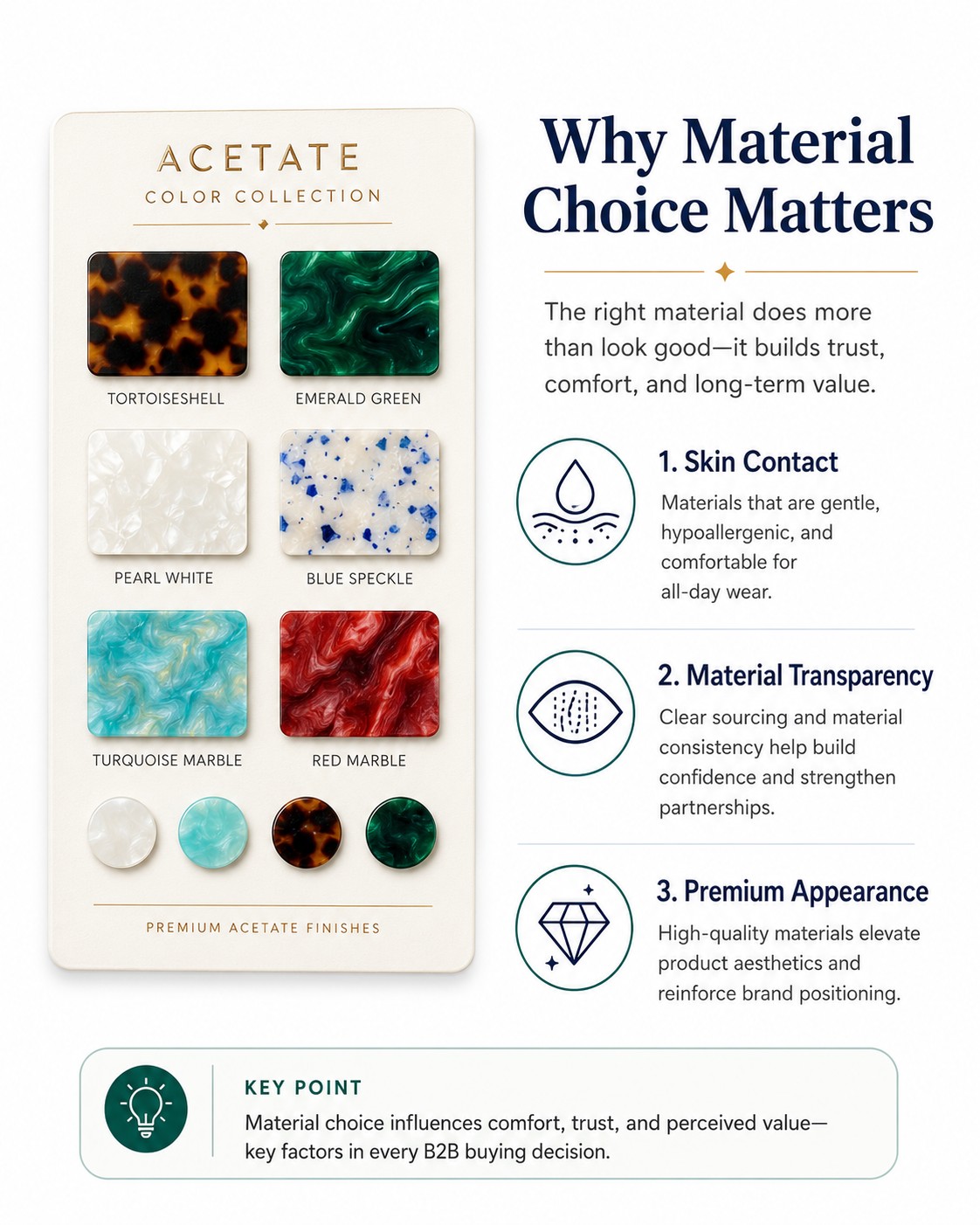
Cellulose acetate is a cellulose-derived thermoplastic material commonly associated with premium eyewear and fashion accessories.
It is especially attractive for watches because it offers:
- Rich color depth
- Smooth polished surfaces
- Tortoiseshell patterns
- Marble effects
- Transparent designs
- Layered color combinations
- Lightweight wearing comfort
- Strong premium-fashion positioning
Acetate is not simply another low-cost molded resin.
When high-quality eyewear-grade acetate is used, the material itself becomes an important part of the product story.
Is Synthetic Resin Toxic?
This question needs a careful answer.
Not every synthetic resin is toxic.
Many synthetic polymer materials are safely used in consumer goods and medical products around the world.
However, B2B buyers should also not assume that every inexpensive resin material is automatically safe simply because the finished watch looks normal.
The potential risk is often associated with the complete formulation, not just the base polymer.
Depending on the resin system and manufacturing process, potential concerns may include:
- Certain plasticizers
- Restricted PAHs
- Uncontrolled pigments
- Residual processing chemicals
- Poor-quality recycled materials
- Unidentified additives
- Insufficient quality control
Therefore, the professional sourcing question should not be:
“Is resin toxic?”
It should be:
“What exactly is in this resin, and can the supplier prove that the finished skin-contact component meets the required chemical standards?”
Why Long-Term Skin Contact Matters
A watch is different from many decorative products.
The bracelet, case back, and other components may remain against the customer's skin for:
- Several hours per day
- Entire working days
- Repeated daily wear
- Long periods in warm conditions
The watch may also be exposed to:
- Perspiration
- Skin oils
- Body temperature
- Friction
- Cosmetics
- Everyday moisture
Because of this prolonged contact, buyers should place more attention on material traceability and chemical compliance than they would for a product that is rarely touched.
This is especially important for:
- Women's watches
- Fashion watches
- Daily-wear watches
- Children's or youth-oriented products
- Lightweight watches designed for long wearing periods
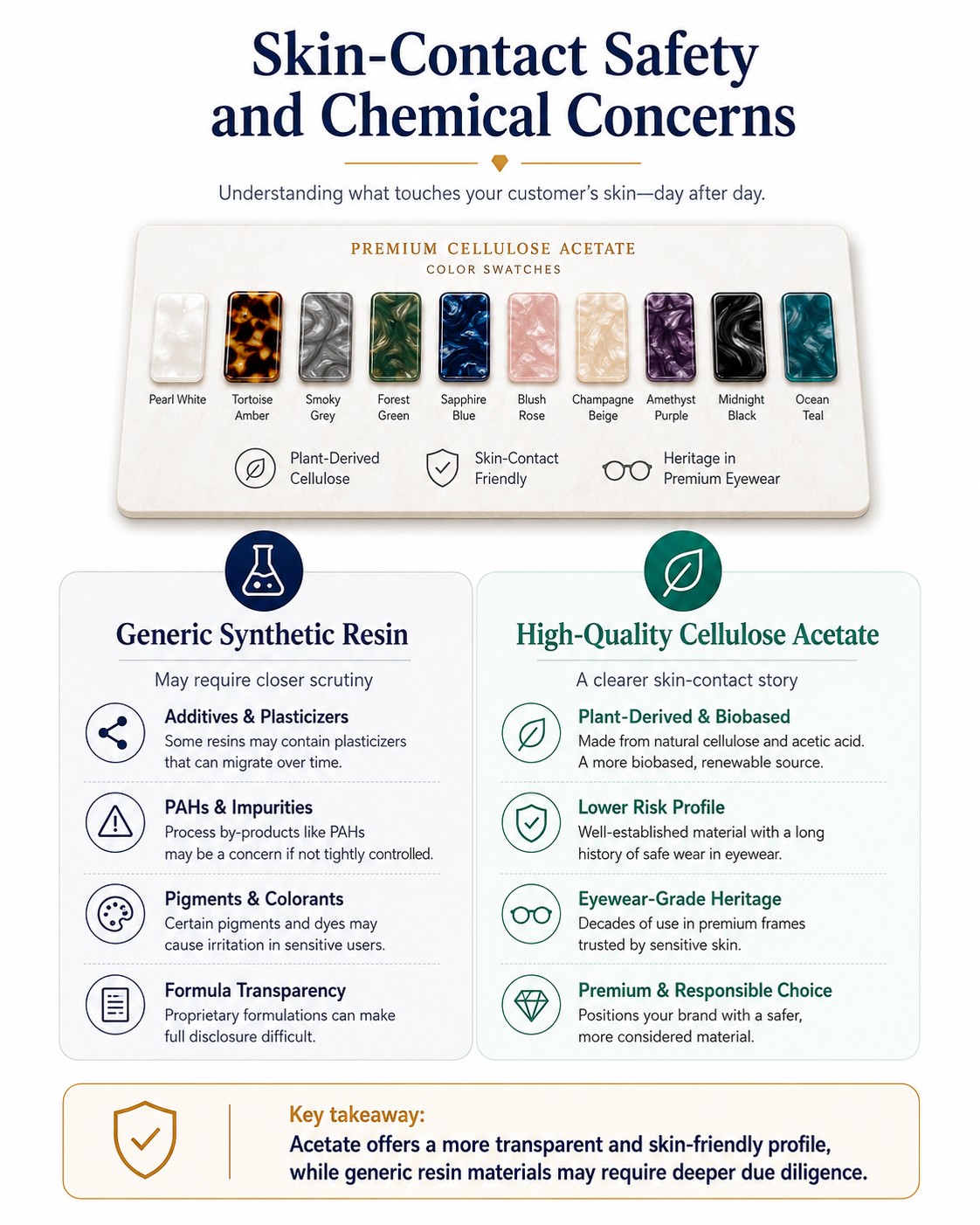
Why Some Synthetic Resin Formulations Require More Attention
The biggest sourcing issue with generic resin is often uncertainty.
If a supplier cannot clearly identify the resin formulation, buyers may not know which substances are present.
For example, certain plastic products may use additives to improve:
- Flexibility
- Color
- Heat resistance
- Processing performance
- Surface appearance
Not every additive is harmful. However, some substances historically used in plastics are now restricted or closely regulated in major markets.
This is why professional B2B sourcing requires documentation rather than assumptions.
Why Plasticizer Control Matters
Certain plastic materials may use plasticizers to achieve specific performance characteristics.
Some phthalate plasticizers have attracted significant regulatory attention because particular substances are associated with reproductive toxicity and are restricted in numerous consumer applications.
For watch buyers, this means a low-cost resin quote should always be evaluated together with:
- Material specification
- Restricted-substance testing
- Supplier quality control
- Destination-market requirements
A lower material cost does not necessarily represent a better commercial decision if the composition is unclear.
Why PAH Testing Can Matter
Certain PAHs are another relevant consideration for plastic and rubber articles that repeatedly contact the skin.
For B2B buyers, this is particularly relevant because watch straps and wristbands are precisely the type of products designed for prolonged or repeated skin contact.
Again, this does not mean that every resin watch contains harmful PAHs.
It means that skin-contact plastic products should be sourced with appropriate material control and testing.
Why Eyewear-Grade Acetate Is Different
One of the strongest arguments for acetate watches is the material's established role in premium eyewear.
High-quality acetate eyewear frames:
- Touch the face
- Contact the temples
- Rest behind the ears
- May be worn for many hours every day
This application requires a material that combines:
- Comfort
- Smooth finishing
- Stable appearance
- Good processing quality
- Suitability for long-term wear
These characteristics translate naturally into fashion-watch design.
For an acetate watch, the same type of material can be used to create a polished case and bracelet that remains comfortable against the wrist throughout the day.
Is Cellulose Acetate Non-Toxic?
Pure cellulose acetate has a favorable hazard profile and an established history in skin-contact applications.
For B2B marketing, however, it is better to use accurate language rather than make unlimited claims such as:
“Acetate can never cause any reaction.”
A more professional statement is:
High-quality cellulose acetate is generally regarded as a low-hazard material with a long history of use in eyewear and other products designed for prolonged contact with intact skin.
The finished watch should still be properly controlled because it may contain:
- Pigments
- Metal components
- Pins
- Coatings
- Adhesives
- Crystal components
- Other watch materials
For this reason, the best sourcing strategy combines high-quality acetate with proper finished-product compliance testing.
Why Acetate Offers a Stronger Skin-Contact Story
When customers wear a watch all day, brands need confidence in the materials that touch their skin.
High-quality eyewear-grade acetate offers B2B buyers a strong story around:
- Established skin-contact use
- Smooth surface texture
- Lightweight comfort
- Clearly identifiable material
- Premium accessory heritage
This makes acetate especially attractive for fashion brands that want customers to wear their watches for long periods.
Rather than simply saying:
“This is a plastic watch.”
the brand can communicate:
“This watch uses high-quality cellulose acetate, a material widely associated with premium eyewear and fashion accessories.”
That is a much stronger product story.
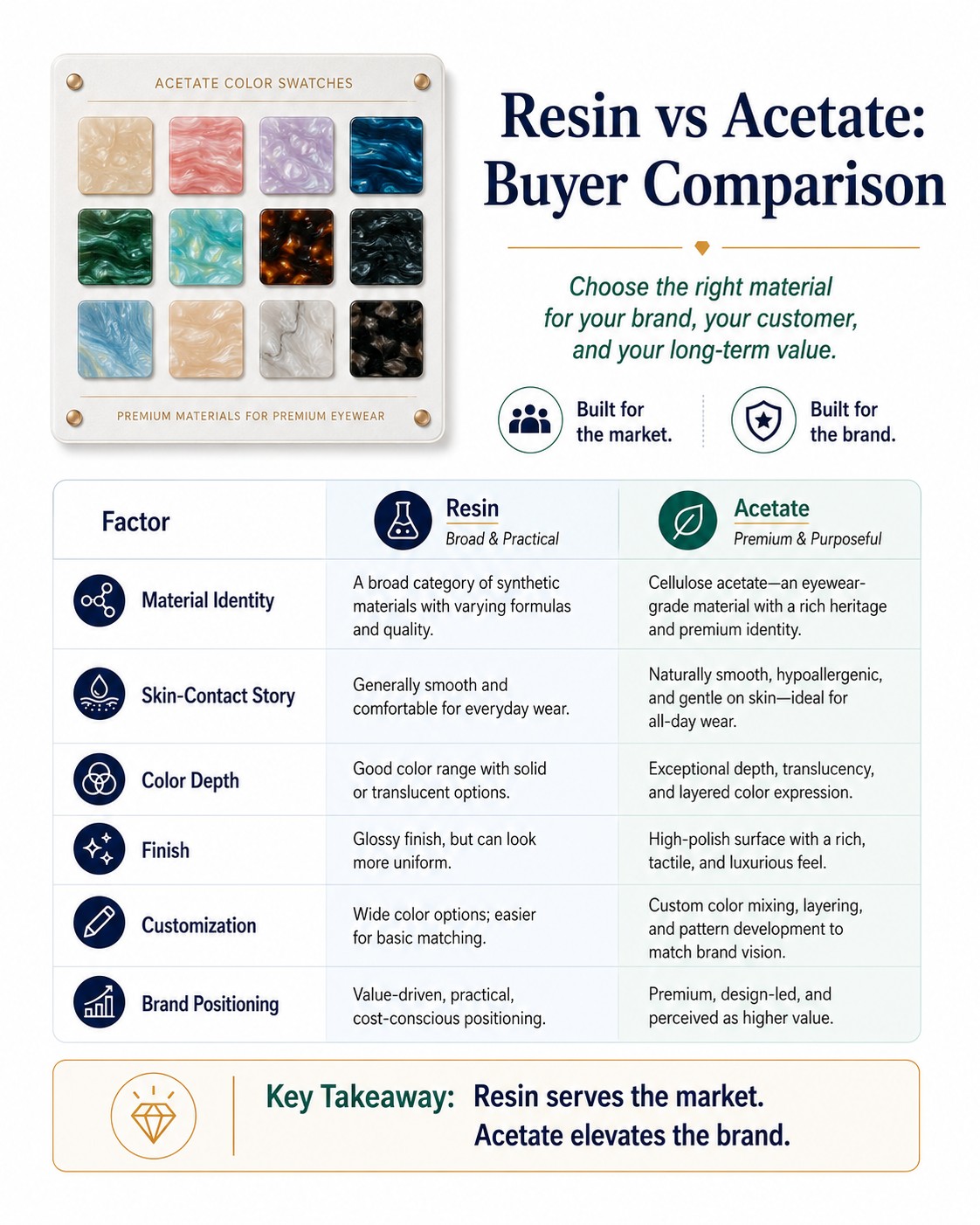
Resin vs Acetate: Key Differences for B2B Buyers
| Factor | Generic Synthetic Resin | High-Quality Cellulose Acetate |
| Material identity | May vary significantly | Clearly identifiable cellulose-derived material |
| Formula transparency | Highly supplier-dependent | Easier to define by acetate grade |
| Skin-contact positioning | Requires verification | Strong established skin-contact story |
| Chemical concerns | Depend on polymer and additives | Still requires compliance, but stronger material foundation |
| Color depth | Often molded or surface-oriented | Rich, layered and dimensional |
| Pattern possibilities | Usually more standardized | Tortoiseshell, marble, translucent and layered effects |
| Surface finish | Depends on resin grade | Excellent polishing potential |
| Comfort | Depends on formulation | Smooth and lightweight |
| Brand positioning | Often cost-driven | Premium fashion-oriented |
| Product storytelling | Limited | Strong connection with eyewear and fashion |
| Best suited for | Budget-focused products | Fashion, boutique and private label collections |
Acetate Is Also a Better Material for Fashion Storytelling
Material safety is important, but acetate offers much more than that.
Fashion watch buyers also need products that look distinctive.
Acetate can produce:
- Tortoiseshell
- Emerald green
- Pearl turquoise
- Crystal transparent tones
- Marble patterns
- Amber
- Blue-and-white combinations
- Layered multicolor effects
These colors and patterns can appear throughout the material rather than simply sitting as a flat coating on the surface.
This gives acetate watches more visual depth.
For brands, the result can feel closer to:
- Premium eyewear
- Jewelry
- Boutique accessories
rather than mass-market molded plastic.
Why Acetate Works Especially Well for Women's Watches
Women often wear watches as part of an overall outfit rather than only as a timekeeping device.
The watch may need to coordinate with:
- Eyewear
- Handbags
- Jewelry
- Clothing
- Seasonal colors
- Business outfits
- Casual looks
Acetate is particularly suitable for this type of product because color and pattern are among its strongest advantages.
Combined with a quartz movement, acetate also allows brands to create watches that are:
- Lightweight
- Comfortable
- Slim
- Easy to wear
- Fashion-oriented
- Suitable for everyday use
For women's fashion-watch collections, this combination can be highly attractive.
Acetate Also Provides a Stronger Premium Position
Generic resin watches are often purchased mainly because they are inexpensive.
This can create a problem for brands.
When the material has very little differentiation, buyers may compare products mainly through price.
Acetate gives brands more ways to communicate value:
- Material story
- Color depth
- Polished texture
- Eyewear-inspired craftsmanship
- Fashion compatibility
- Custom pattern development
This can help move the sales conversation away from:
“Which watch is cheapest?”
toward:
“Which watch offers a more distinctive design and stronger material value?”
For private label and boutique brands, this difference can be significant.
Is Acetate More Environmentally Friendly?
Acetate begins with cellulose, which is derived from plant-based raw materials such as wood pulp or cotton linters.
This gives acetate a different material origin story from many fully petroleum-derived synthetic plastics.
However, B2B buyers should avoid making broad claims such as:
“All acetate is completely biodegradable” or “acetate has no environmental impact.”
Environmental performance depends on:
- Raw material sourcing
- Plasticizers
- Manufacturing processes
- Energy use
- Product lifetime
- Waste treatment
A more accurate commercial message is:
Cellulose acetate offers a cellulose-derived material foundation and can support a stronger bio-based material story than many conventional synthetic resin products.
This is more credible for professional buyers.
What B2B Buyers Should Ask a Resin Watch Supplier
If you are sourcing resin watches, do not accept “resin” as the complete material specification.
Ask:
1. What Is the Exact Polymer?
The supplier should be able to identify the material.
2. Is Virgin or Recycled Material Used?
If recycled material is used, ask about traceability and restricted-substance controls.
3. Which Plasticizers Are Used?
Ask whether relevant restricted phthalates have been controlled.
4. Has the Product Been Tested for PAHs?
This is particularly important for components that remain against the skin.
5. What Pigments and Additives Are Used?
Colorants and additives should also form part of chemical compliance management.
6. Can the Supplier Provide Current Test Reports?
Make sure the report corresponds to the actual material being ordered.
7. Does the Material Meet Your Destination Market's Requirements?
Requirements can differ between the EU, United States, and other regions.
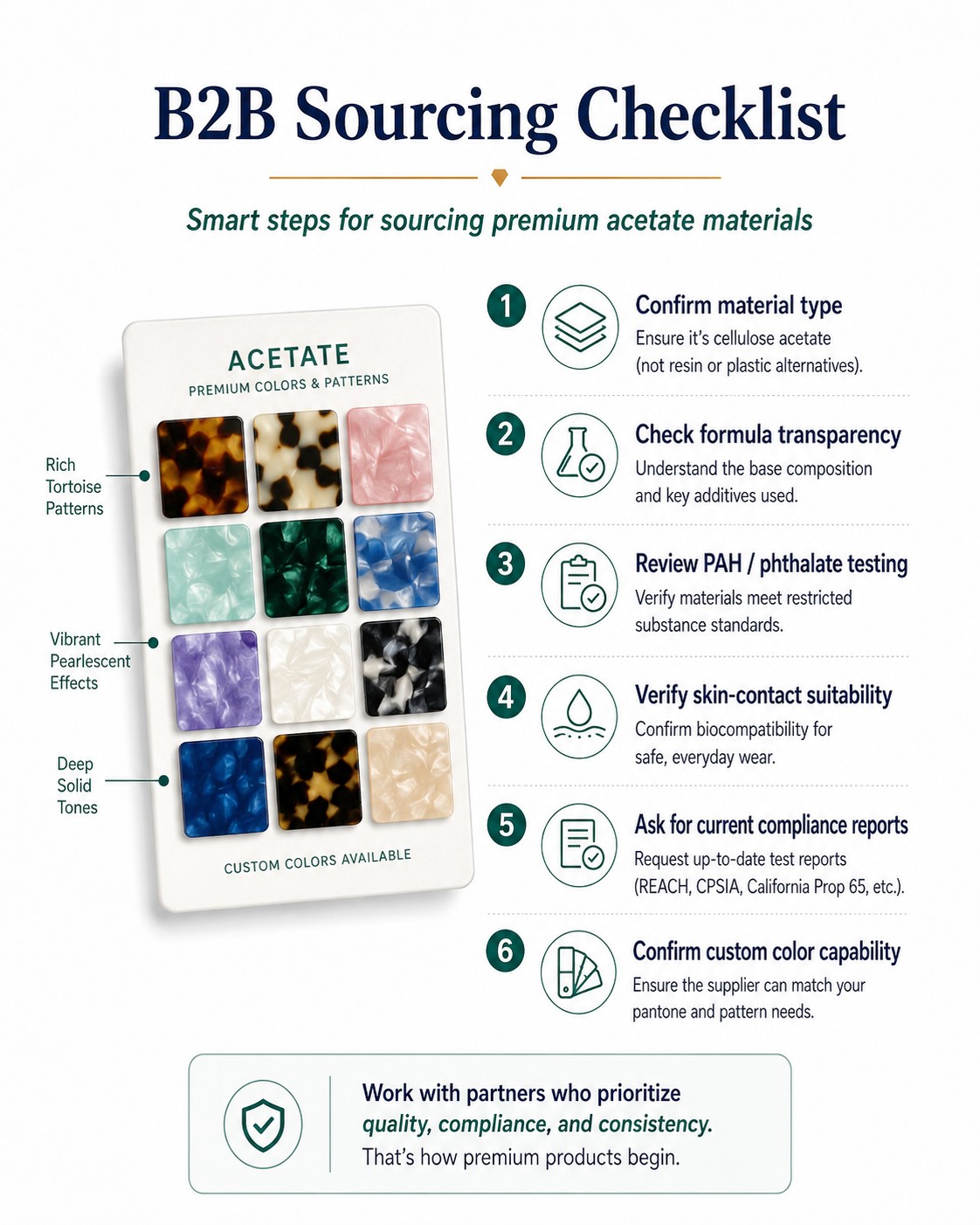
What B2B Buyers Should Ask an Acetate Watch Supplier
When sourcing एसिटेट घड़ियाँ, buyers should ask:
Is It Real Cellulose Acetate?
“Acetate look” and actual cellulose acetate are not necessarily the same thing.
Is Eyewear-Grade Acetate Used?
This can help support better material consistency, finishing, and positioning.
Can the Material Source Be Identified?
Material traceability gives buyers more confidence.
Is Compliance Documentation Available?
High-quality material does not replace professional compliance control.
Can Custom Colors Be Developed?
This is one of acetate's most important advantages.
Can Custom Patterns Be Developed?
Brands can create exclusive marble, tortoiseshell, pearl, translucent, or layered styles.
What Polishing Process Is Used?
Good polishing is essential for achieving the premium acetate appearance.
Why Testing Still Matters for Acetate Watches
Choosing acetate does not mean buyers should stop testing.
The final product includes much more than the acetate itself.
For example, an acetate watch may contain:
- Stainless steel pins
- Metal clasps
- Crown components
- Pigments
- Adhesives
- Quartz movement
- Crystal
- Dial coatings
Therefore, responsible B2B sourcing should always evaluate the finished product according to the requirements of the destination market.
The right message is:
Acetate provides a strong material foundation; compliance testing confirms the safety and quality of the finished product.
The Most Important Question: What Is Touching Your Customer's Skin?
For B2B buyers, this is perhaps the most important sourcing question.
A watch may remain on the wrist for eight, ten, or even more hours per day.
If the material is simply described as:
“Synthetic resin”
ask for more information.
If the supplier can instead specify:
“High-quality cellulose acetate with traceable material sourcing and relevant compliance documentation,”
the buyer has a much clearer understanding of the product.
This supports:
- Customer confidence
- Retailer confidence
- Brand reputation
- Product compliance
- Premium positioning
- Long-term cooperation
Why Fashion Brands Are Paying More Attention to Acetate
Modern fashion brands need products that combine design and material value.
Acetate provides both.
It gives designers:
- More color freedom
- Better pattern depth
- Premium polish
- Lightweight comfort
- Strong outfit-matching possibilities
It also provides sourcing teams with a much clearer material story than generic resin.
For brands that want something different from ordinary plastic watches, acetate represents a strong direction.
Final Thoughts
When comparing resin vs acetate watch materials, B2B buyers should look beyond price.
Synthetic resin is a broad category. Many resin materials can be safely used when properly formulated and tested, but unknown or poorly controlled formulations can create unnecessary sourcing risks because their additives, plasticizers, pigments, PAHs, or recycled content may not be transparent.
For a product designed to remain directly against the skin, this uncertainty deserves attention.
High-quality cellulose acetate, especially eyewear-grade acetate, offers a stronger alternative for fashion-watch development. It has an established history in products worn against the skin and provides additional advantages in color depth, polishing, lightweight comfort, customization, and premium brand positioning.
For brands, distributors, retailers, and private label buyers, the best sourcing principle is simple:
Do not choose a watch material only because it is cheaper. Understand what it is made from, verify its compliance, and consider what your customer will wear against their skin every day.
For premium fashion collections, एसिटेट घड़ियाँ offer a compelling combination of material confidence, design freedom, comfort, and stronger brand value.

टिप्पणी करें ( 0 टिपण्णी )
टिप्पणियाँ बंद कर दी गयी है.